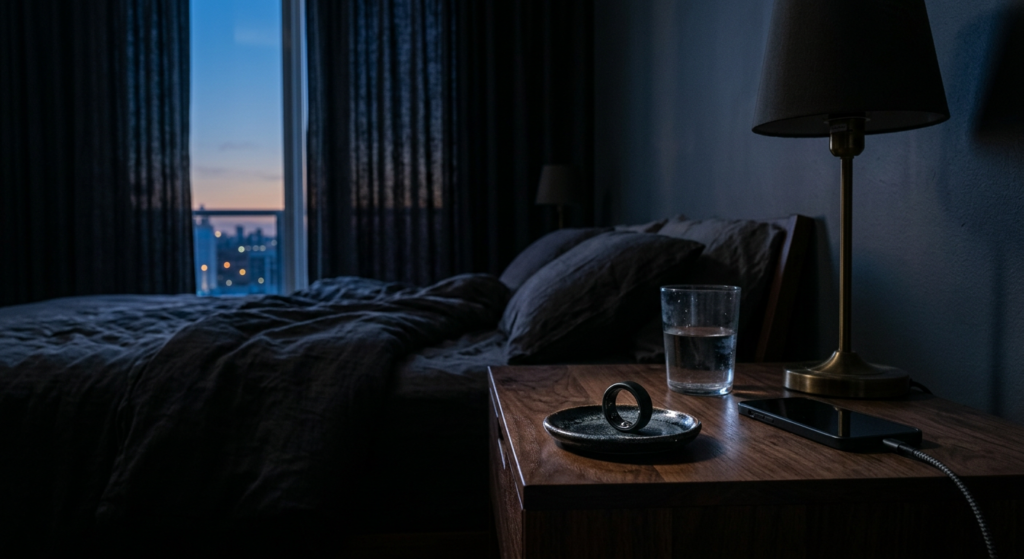
For years I told people I was ‘fine on six hours,’ which is the kind of thing men my age say with a straight face and no evidence behind it whatsoever. I felt tired most afternoons and assumed that was just what afternoons were now, a fact of being in your forties the way a bad knee is a fact of being in your forties. Coffee got me through it. I didn’t think there was more to investigate, because as far as I could tell, I was already doing the investigating — I was awake, I remembered going to bed, I remembered waking up. Case closed, as far as I was concerned.
What I couldn’t see myself
My wife got me a sleep tracking ring for my birthday, mostly, I think, because she was tired of hearing about my energy crashes and wanted data instead of my guesswork. I wore it skeptically for the first week expecting it to confirm I was basically fine, maybe dock me a point or two for staying up too late scrolling, nothing dramatic.
It did not confirm that. What it showed instead was a pattern I hadn’t noticed because I was asleep for the part that mattered: I was waking up, briefly, four or five times a night, almost never remembering it by morning. Six hours in bed was turning into something closer to four and a half hours of actual continuous sleep once you subtracted the fragments, which is a number that explained a decade of afternoons I’d blamed on everything except the actual cause.
Chasing down the why
The ‘why’ took a bit more digging than the ring alone could tell me. Some of it was streetlight bleeding through curtains that I’d always considered good enough, the kind of curtains you buy once and never think about again. Some of it was the dog, who apparently patrols the hallway around 2 a.m. and always has, I just never knew it was waking me, since by morning the memory had evaporated along with the rest of the night. Some of it, honestly, was a room that was too warm because I’d never bothered to test that theory, having assumed for years that temperature was a comfort preference rather than a sleep variable.
Blackout curtains made the single biggest difference of anything I changed, which surprised me because it felt like the most boring fix on the list, the kind of thing you’d skip past looking for something more interesting. The room went from grey to genuinely dark, and the wake-up count on the ring started dropping within the first week. A white noise machine handled the dog situation, or at least handled my reaction to the dog situation, since I stopped surfacing every time she clicked down the hall at whatever hour she’d decided needed patrolling.
What actually changed
What actually changed for me wasn’t the number of hours, which crept up only slightly. It was the quality inside those hours. The afternoon crash I’d blamed on my job, my age, my diet, mostly disappeared once I was getting real uninterrupted sleep instead of six hours stitched together out of fragments I never remembered having.
I don’t think the ring itself fixed anything. It just showed me a problem I’d been sleepwalking past, literally, for years. I’m not sure I would have believed I had a sleep problem without seeing it laid out in front of me, because on paper, six hours in bed sounded fine, and I’d built an entire identity around being someone who functioned well on not much sleep.
This article is for general informational purposes and isn’t a substitute for professional medical advice. If you suspect a sleep disorder, talk to a doctor rather than relying on consumer tracking devices alone.
Sleep as a variable, not a virtue
The bigger shift for me wasn’t curtains or a ring, it was realizing I’d spent years treating sleep as a character trait instead of a variable I could actually change. ‘I’m just not a great sleeper’ is a sentence I said for a decade, the same way you might say ‘I’m just not a morning person,’ as if it were fixed and unrelated to anything measurable. Once I saw the data, sleep stopped being an identity and started being a set of conditions I could adjust one at a time. That reframing did almost as much for me as the curtains themselves.
Shop This Guide
| Item | Pick | Price Tier | Why It Earns Its Spot |
|---|---|---|---|
| Sleep Tracking Ring | Sleep Tracking Ring | $300–400 | Shows fragmented sleep you'd never notice or remember yourself |
| Blackout Curtains | Blackout Curtains | $30–60 | The single biggest fix, and the most overlooked one |
| White Noise Machine | White Noise Machine | $25–50 | Covers the household noise that wakes you without you knowing it |
As an Amazon Associate, Legacy Gent earns from qualifying purchases.