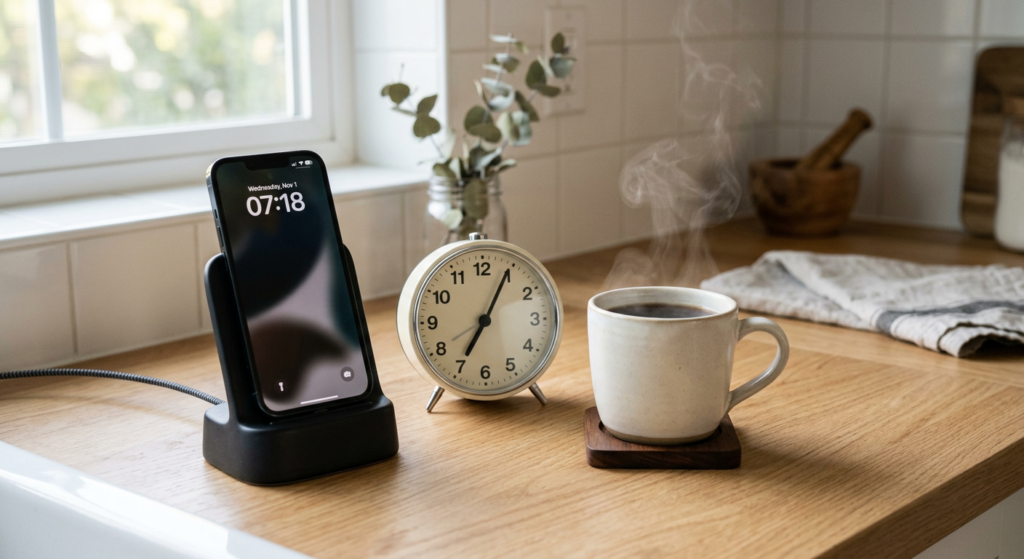
My mornings used to start the same way for years: alarm goes off on my phone, I silence it, and then, because the phone is already in my hand, I open something. Email, usually. Sometimes news. Once in a while a work Slack notification that had come in at midnight and now felt urgent at 6:15 a.m. before I’d even sat up in bed, before my eyes had fully adjusted to the light of the screen I was already staring into.
A default I never chose
I never decided to do this. It just became the default, because the phone was the alarm clock, and the alarm clock lived six inches from my head all night. Turning it off meant it was already unlocked in my hand, and unlocking it for one reason made every other reason equally available, the way opening the fridge for milk somehow ends with you eating three things you hadn’t planned on.
I tried a handful of productivity apps to fix this, ironically making the problem worse — now I had a morning routine app reminding me to open the morning routine app, one more notification competing with the email and the Slack messages for the first slot of my attention. Every fix I tried lived on the same device as the problem, which meant I was never actually removing the temptation, just adding a competitor to it.
The fix was subtraction, not addition
What actually worked was deleting the email app off my phone entirely, not just logging out, actually removing it, so that checking email required opening a laptop I’d left in another room. That single friction point — walking to another room, waiting for a laptop to wake up — turned out to be enough to break a habit that years of willpower alone hadn’t touched.
That one deletion changed more than I expected, but it only worked because I paired it with something physical: an actual alarm clock, the kind that just makes noise and doesn’t do anything else. The phone now charges on a dock in the kitchen overnight, out of the bedroom completely, which means the first thing I touch in the morning is genuinely nothing. No screen. No notification badge waiting to be resolved before I’ve had coffee, no red dot pulling my attention before I’ve even stood up.
The first few mornings without it felt strange in a way I wasn’t prepared for, almost like a small withdrawal. I kept reaching toward the nightstand for a phone that wasn’t there, an instinct that took nearly two weeks to fully fade. But within a week the mornings had slowed down in a way I hadn’t managed with any app or system — I was making coffee, sitting for a few minutes, actually waking up before the world’s list of demands showed up to greet me at the door.
I still check email eventually, obviously, I have a job. But it happens after I’ve had a normal human morning instead of before it, and that order turned out to matter more than I ever would have guessed. The fix wasn’t a better app. It was fewer apps, and a little more distance between my bed and my phone, which sounds too simple to have taken me a decade to figure out.
The quiet math I never ran
Looking back, I think what kept the old habit going so long was that I never actually calculated the cost. Ten minutes of email before I’m out of bed doesn’t feel like much in the moment. But over a year, that’s dozens of hours spent starting the day reactive instead of on my own terms, absorbing someone else’s priorities before I’d even decided what mine were for the day. I never sat down and did that math while it was happening. It took removing the habit entirely to see the shape of what it had been costing me.
What I’ve noticed since making this change is how much it’s shifted the rest of the day too, not just the first ten minutes. Starting the morning without absorbing someone else’s urgency seems to set a different tone that lasts longer than I expected — I’m less reactive by 10 a.m., less likely to let one bad email derail an afternoon. I didn’t plan for that ripple effect. I just wanted to stop waking up to a inbox, and the rest turned out to be a bonus I didn’t know to expect.
Shop This Guide
| Item | Pick | Price Tier | Why It Earns Its Spot |
|---|---|---|---|
| Analog Alarm Clock | Analog Alarm Clock | $20–35 | Lets your phone leave the bedroom entirely, for good |
| Charging Dock | Charging Dock | $25–40 | Gives the phone somewhere to live that isn't six inches from your head |
As an Amazon Associate, Legacy Gent earns from qualifying purchases.