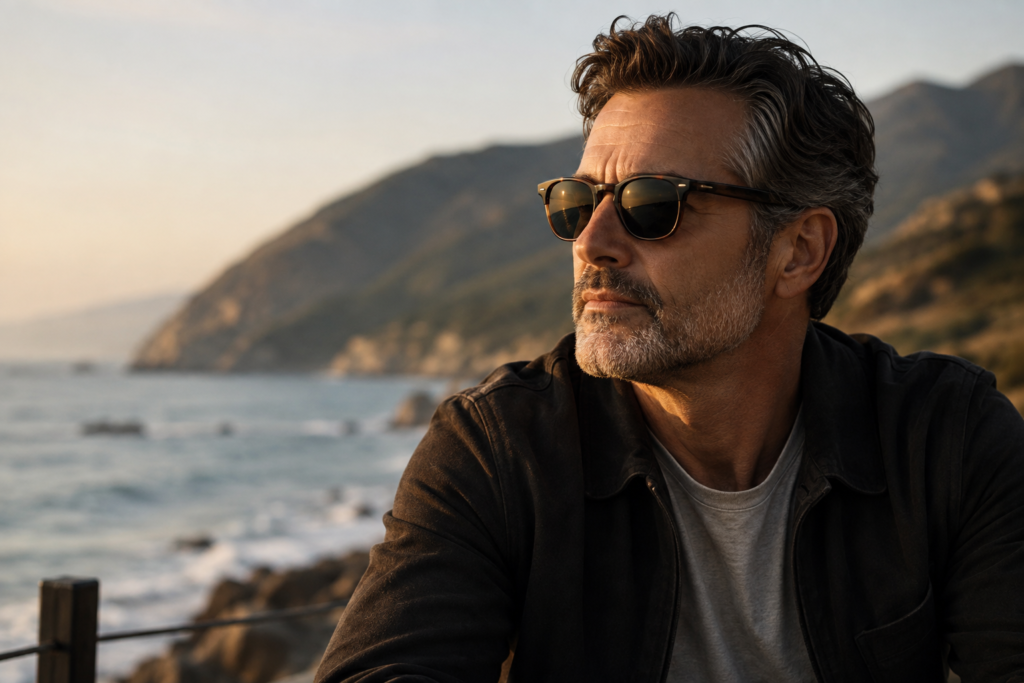
For most of my adult life my approach to sunglasses was whatever was sitting in the gas station rack by the register, usually somewhere between eight and fifteen dollars, purchased in a mild panic because I’d forgotten mine again and the sun was doing something unreasonable to my eyes on the highway. I went through probably twenty pairs this way over two decades. I never once thought of sunglasses as something worth actually choosing.
What an eye doctor said that changed my mind
What changed wasn’t vanity, it was a comment from an eye doctor during a routine exam, who asked, almost casually, what kind of UV protection my sunglasses had. I genuinely didn’t know. I’d never checked. She explained, patiently and without any particular alarm, that a lot of cheap sunglasses provide the sensation of protection — the world gets darker, so it feels like you’re shielded — without the actual UV filtering that matters, and that dark lenses with no real UV protection can be worse than no sunglasses at all, because your pupils dilate in the dark tint and let in more of what little UV does get through.
That one comment sent me down a rabbit hole I’d avoided for twenty years, and I came out the other side finally understanding that “sunglasses” isn’t really one category of product. There’s a real difference between something that blocks glare and something that actually protects your eyes, and after two decades of gas station purchases I’d never once bought the second kind on purpose.
What actually changed once I upgraded
The first real pair I bought were polarized, which I’d always assumed was a marketing word without much behind it. It wasn’t. Driving toward the sun on the highway went from a genuine hazard, squinting through glare bouncing off other cars and wet pavement, to something I barely thought about. I noticed it most on the water, where the glare off a lake had always bothered me and I’d never connected that specific problem to a specific lens feature I could just buy.
The second thing that changed was durability, in a way that actually saved me money over the gas station approach rather than costing more in the long run. A twelve-dollar pair lasts a season before the arm snaps or a lens pops out. A real pair, cared for reasonably, is still going strong three years later, which means the math on “cheap” sunglasses was never actually in my favor once you counted how many pairs I was buying a year.
Building out more than one pair
I’ve since settled into having a small, deliberate rotation rather than one all-purpose pair, which sounds excessive until you notice how differently you use sunglasses driving versus running versus just walking around a city in July. A classic polarized pair handles daily wear and driving. A wraparound sport pair, the kind that actually stays put, handles runs and anything active where a slipping pair is more than an annoyance. Below is what I’d point a friend toward if he asked me where to start, now that I actually know what I’m looking at.
Shop This Guide
| Item | Pick | Price Tier | Why It Earns Its Spot |
|---|---|---|---|
| Everyday Polarized Aviators | Polarized Aviators | $60–120 | Cuts driving and water glare that tinted lenses alone never actually fix |
| Sport Wraparound Sunglasses | Sport Wraparounds | $40–90 | Stays put through runs instead of sliding down at the worst moment |
| Hard Shell Sunglasses Case | Hard Shell Case | $10–20 | The unglamorous reason a real pair actually lasts past one season |
As an Amazon Associate, Legacy Gent earns from qualifying purchases.
The real cost of never checking
I went twenty years without ever asking what was actually in the sunglasses I was buying, and the honest answer is I got lucky that nothing worse came of it. I don’t think about sunglasses as a small, forgettable purchase anymore. They’re doing an actual job, quietly, every time I’m outside in daylight, and it took an offhand comment from a doctor to make me finally treat them like it.