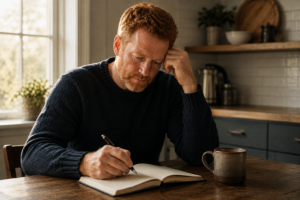
For most of my 30s, I had a rule I never said out loud: I’d do the big things once I felt ready. Change jobs once I felt ready. Have the hard conversation once I felt ready. Start the project once I felt ready. The problem is, ready never showed up. It was always six months away, tied to some version of me who had it more together.
I used to think this was just prudence. Careful planning, responsible adulthood, the mature thing to do. Looking back, most of it was fear wearing a competence costume. Waiting felt productive because I was always “preparing,” even when the preparing had quietly stopped producing anything and just become a way of not deciding.
What finally broke the pattern wasn’t a breakthrough. It was a deadline that didn’t care how I felt. A project at work landed on my desk with a two-week turnaround, no room to prepare, no time to feel ready. I did it anyway, badly at first, fumbling through the parts I hadn’t fully thought through. It worked out fine. Better than fine, actually. Nobody noticed the parts I was unsure about. They just saw the finished thing.
That’s when it clicked: readiness isn’t a precondition for competence, it’s a byproduct of it. You don’t feel ready and then act. You act, badly and uncertainly, and the feeling of readiness shows up afterward, usually around the third or fourth time you’ve done the thing. By the time you feel ready, you’ve usually already proven you didn’t need to.
I started testing this everywhere, deliberately, almost like an experiment on myself. The conversation with my brother about money I’d been putting off for a year, I had it without a script, sitting across from him at a diner instead of rehearsing it in my head for another month. The pitch for a business idea I’d been polishing in my head for months, I sent a rough version instead of the perfect one, typos and all. Every time, the fear of not being ready turned out to be bigger than the actual cost of being unprepared.
None of this means recklessness is a virtue. Preparation matters, and there are things worth thinking through carefully before you move. But there’s a difference between preparing and stalling, and after 40 I’ve gotten a lot better at telling them apart. Stalling feels like preparation. It has the same shape, the same busy feeling of doing something useful. But it never actually produces the readiness it promises, because readiness was never the thing standing in the way. The doubt was always going to be there. The only question was whether I’d act with it or wait for it to leave first.
What surprised me most was how much of my hesitation had nothing to do with the actual task and everything to do with how I’d feel doing it imperfectly in front of people. Once I separated those two things, the actual task usually turned out to be manageable. It was the imagined audience in my head, judging the rough draft, that had been stopping me the whole time.
I still catch myself slipping back into the old pattern sometimes, especially with anything that touches on how I’ll be perceived rather than just what needs to get done. The difference now is I notice it faster. I’ll catch myself drafting the fifth version of an email that the first version would have handled fine, and I recognize the shape of it: not care, just stalling dressed up as care.
The years you have left are not a rough draft. Waiting to feel ready is just a slower way of saying no, and most of the things worth doing were never going to feel comfortable on the way in. The comfort, when it comes, comes after.
I’ve noticed the same pattern in almost every man I know who’s over 40 and stuck on something. It’s rarely a lack of ability holding them back. It’s the story that the ability needs to be fully formed before it’s allowed out into the world, that showing up half-finished is a kind of failure rather than just what beginning actually looks like. Nobody tells you that the first draft of anything, a business, a conversation, a skill, is supposed to be rough. We only ever see other people’s finished versions, which makes our own rough drafts feel like evidence we’re not cut out for it, when really they’re just evidence that we started.
There’s also a quieter cost to waiting that doesn’t get talked about enough: the compounding effect of not acting. Every month you wait to have the hard conversation is a month the resentment or distance has to grow. Every month you wait to start the project is a month a competitor, or just time itself, gets ahead of you. Waiting isn’t neutral. It isn’t a pause button. It’s actively costing you something, even when it feels like the safe, responsible choice.
If I had to boil this down to one practical habit, it’s this: whenever I notice myself waiting to feel ready for something, I now ask a different question entirely. Not “do I feel ready,” but “what’s the smallest version of this I could do today.” Almost always, there’s a version small enough to start immediately, and starting small turns out to be the fastest route to the readiness I was waiting around for in the first place.