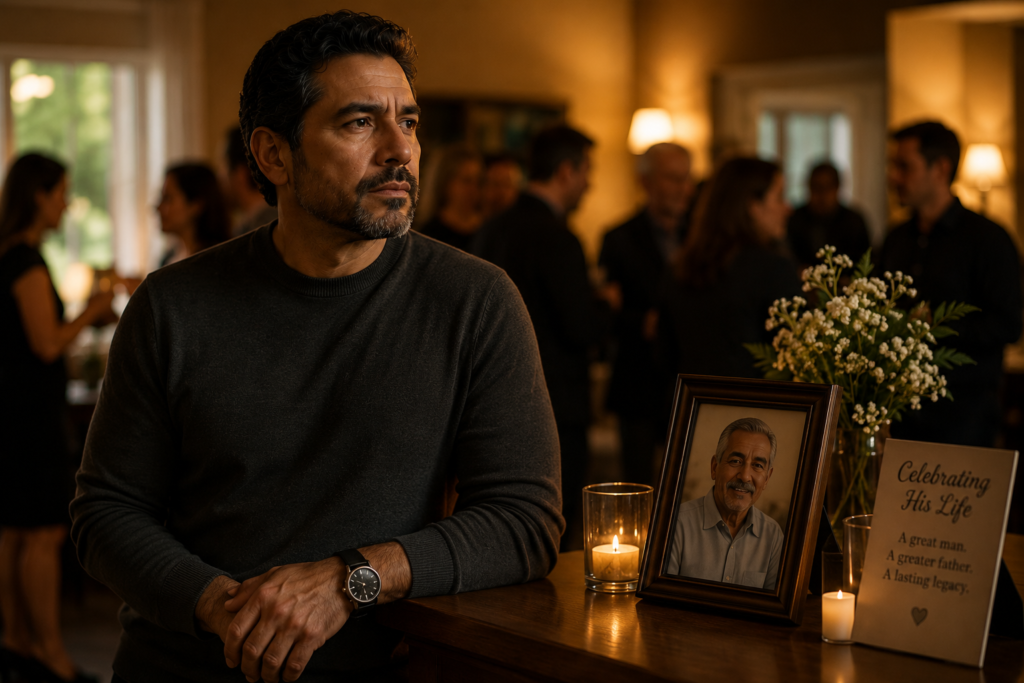
I wrote the eulogy in about forty minutes, sitting at my dad’s kitchen table two days after he died. Not because I was calm, but because once I started, the things I actually wanted to say came out faster than I expected, like they’d been waiting somewhere for years for an occasion that finally forced them out. Most of it wasn’t about him, not directly. It was about who I’d been as his son, and how much of that I’d gotten wrong for a long time without ever quite admitting it.
I spent my 20s and a chunk of my 30s a little embarrassed by him, if I’m being honest about it in a way I never was while he was alive. He wasn’t dramatic or difficult, just quiet and unimpressive by the standards I’d absorbed somewhere, the ones that measure fathers by ambition and stories worth telling at parties. He worked the same job for thirty-one years. He never once raised his voice that I can remember. Next to the fathers of friends who ran businesses or traveled for work or had some kind of larger-than-life presence, mine seemed almost invisible, and I let that comparison shape how I saw him for longer than I’m proud of.
It took me until my late 30s to understand that showing up every single day, without fail, without needing credit for it, was its own kind of remarkable that I’d been too young and too distracted to recognize. Every school event. Every practice, even the ones in the rain that nobody would have blamed him for skipping. He never mentioned it, never used it as leverage in an argument the way I’ve heard other fathers do. He just did it, over and over, for decades, and I’d mistaken the quiet consistency of it for a lack of anything worth noticing.
Standing at the podium, I found myself talking directly to a version of myself from fifteen years earlier, the one who still had time to fix this while he was alive and didn’t use it. Telling him to stop waiting for some big, obvious moment of connection with his father and just show up for the small ones instead, because the small ones were the whole relationship, disguised as nothing. There was never going to be a dramatic breakthrough conversation. There were only going to be a thousand small, unremarkable Tuesdays, and I’d spent too many of them elsewhere, distracted, assuming there would always be more.
What surprised me afterward wasn’t grief, though there was plenty of that in the weeks that followed. It was how much clarity came from finally saying it out loud, in front of people, instead of carrying it around as a private regret the way I had for years. Regret you never voice just sits there, unresolved, taking up quiet space in the background of everything else. Regret you say out loud, even once, even to a room of people who already knew most of it anyway, becomes something you can actually put down, or at least set down long enough to breathe.
I don’t get another chance with him, and no eulogy changes that fact no matter how honest it is. But I’ve got kids of my own now, and the version of myself I addressed at that podium is still around, still fully capable of showing up for the small, unremarkable moments instead of waiting for the big ones that mostly never come. That’s the only part of the lesson that still matters, the only part I actually get to act on now. Everything else is just something I understand too late to use with him, and in time.
My mother told me afterward that it was the first time she’d seen me really talk about him rather than just around him, and I think she was right. Growing up, if you’d asked me to describe my father, I would have listed facts, his job, his routines, the way he liked his coffee, rather than anything about who he actually was underneath the facts. Writing the eulogy was the first time I’d ever really tried to answer that harder question, and I was surprised by how much I actually knew once I stopped skating past it.
A few cousins came up to me afterward and said some version of the same thing, that they recognized their own fathers in what I’d said, the quiet, uncelebrated kind of presence that doesn’t announce itself and so goes unnoticed until it’s gone. That surprised me too. I’d written something intensely specific to my dad, and it turned out to describe an entire generation of fathers who never got the credit for just being there, day after day, without asking for it.
I’ve started being more deliberate since about actually telling people what I appreciate about them while they’re still around to hear it, instead of saving it for a eulogy. It’s an uncomfortable habit to build, saying the earnest thing out loud instead of assuming it’s understood. But I’d rather feel a little exposed now than write another speech someday explaining what I should have said years earlier.