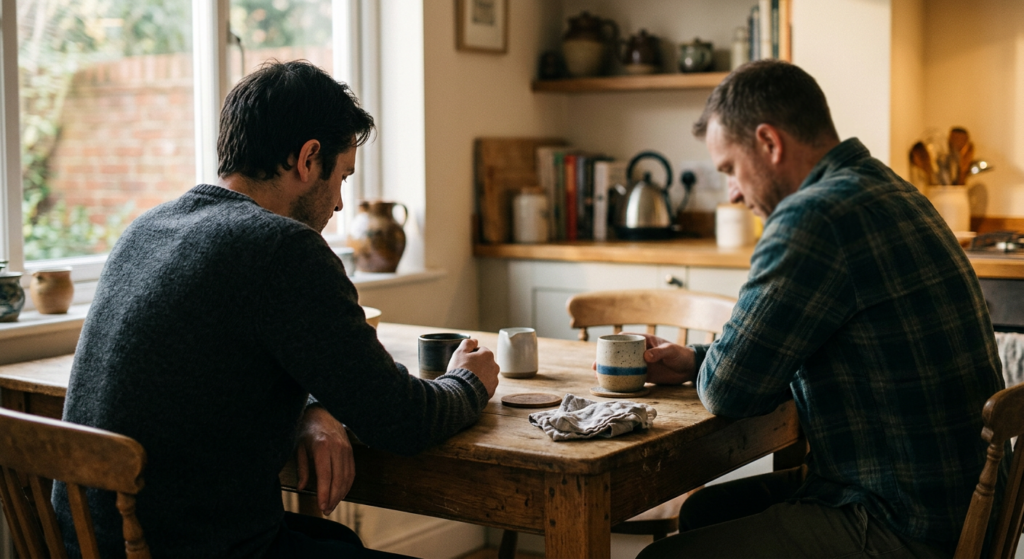
My dad and I have never really talked about anything that mattered. Sports, weather, the state of his gutters, sure — those conversations we’ve had a thousand times and could have again tomorrow without either of us thinking twice. But anything real, anything about how he actually felt about his life or what he wanted for the years he has left, that territory stayed closed for most of my adult life, by some unspoken agreement neither of us ever actually made out loud.
The sentence I kept telling myself
I told myself there’d be time. That’s the sentence I kept using, silently, every time an opening came up and I let it pass. A phone call where he mentioned feeling tired more than usual. A visit where he seemed smaller in his recliner than I remembered him being just a year before. Each time, some part of me clocked it and then moved the conversation somewhere safer, because it felt easier than facing what the real conversation might turn into, and easier still to just assume next year would be the year I finally brought it up.
What finally broke the pattern was almost nothing — a friend of mine lost his father suddenly, no warning, and mentioned at the funeral that there was a conversation he’d been meaning to have for two years that he now never would. He wasn’t being dramatic about it. He said it flatly, like a fact he now had to live with for the rest of his life. I couldn’t stop thinking about it for weeks, turning it over on drives home, unable to shake the specific flatness of how he’d said it.
The call
I called my dad on a random Tuesday, no occasion, and I didn’t ease into it the way I usually would have. I just told him I wanted to know what he actually thought about getting older, what scared him about it, what he wished he’d done differently. There was a long pause on the line, long enough that I almost filled it with something easier, almost retreated to the gutters and the weather out of pure discomfort.
He talked for almost forty minutes. Things I’d genuinely never heard — regrets about time he didn’t spend with his own father before he passed, a fear about becoming a burden that he’d apparently been carrying alone for years without ever mentioning it to a single person, a specific memory from his twenties he’d never once brought up in my entire life. None of it was comfortable. All of it mattered more than every conversation about gutters we’d ever had combined, and I found myself taking mental notes like I was trying to memorize a version of him I’d never had access to before.
I don’t know why I waited so long, except that the conversation felt like it might change something between us, and I think some part of me preferred the safety of not knowing over the risk of finding out. I was wrong about that. The knowing was better, even the hard parts of it, and I wish I hadn’t needed someone else’s loss to finally go looking for it myself.
What I do differently now
Since that call, I’ve tried to keep a mental list of the questions I still haven’t asked him, so I don’t let another decade pass on the assumption there’ll always be a next visit. It feels strange to plan for conversations that way, almost clinical, but the alternative is trusting that time will sort itself out, and I already know from experience that it doesn’t. My dad and I still talk about gutters plenty. We just don’t only talk about gutters anymore, and that difference has turned out to matter more than either of us expected it to.