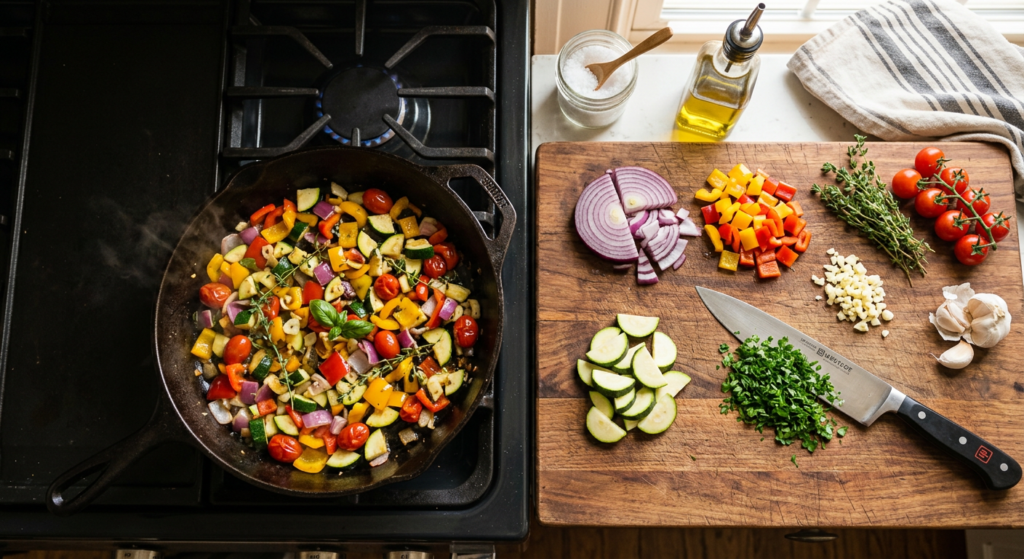
Somewhere in my late thirties, cooking quietly disappeared from my life. Not all at once — it was takeout on the nights I was tired, then the nights I was ‘kind of’ tired, then most weeknights, until I looked up and realized I hadn’t actually cooked a full meal in longer than I could remember. I told myself it was about time, which was partly true and partly an excuse for not wanting to deal with dishes after a long day, a trade I made so gradually I never noticed I was making it.
The question I didn’t have an answer for
What got me back into it wasn’t a health kick, despite what you might expect from an article like this. It was my daughter asking, completely without an agenda, why I never cooked anymore, since she remembered me doing it when she was little. I didn’t have a good answer. I just said I’d gotten out of the habit, which was true and also felt like a strange thing to admit out loud to a kid who apparently had a clearer memory of the old routine than I did.
I started small on purpose, because my first attempt to ‘get back into cooking’ years earlier had involved buying a stack of ambitious cookbooks and burning out after two weekend projects that took three hours each, projects so involved I never wanted to repeat them. This time I picked one pan and decided to actually learn it, rather than chasing a different recipe every night and starting from zero each time.
Depth over variety
A cast iron skillet turned out to be the right choice, mostly because it does almost everything — a steak, eggs, roasted vegetables, a pan sauce — and because using the same pan repeatedly meant I was actually learning how it behaved instead of fumbling with a new tool every time. There’s something to be said for depth over variety when you’re rebuilding a habit from nothing, the same way you’d rather get good at one exercise than mediocre at ten.
The knife mattered more than I expected too. I’d been using a dull one for years without noticing, the way you don’t notice a lot of small frictions until they’re gone, and a decent chef’s knife made prep feel like a task instead of a fight against my own tools. Cooking got faster and, more importantly, less annoying, which is usually the difference between a habit that sticks and one that quietly dies again within a month.
Glass containers ended up mattering just as much, in a quieter way. Leftovers I used to forget in the back of the fridge, buried in plastic containers that all looked the same, started actually getting eaten because I could see what was in them at a glance. Small thing, but it meant less food wasted and fewer excuses to order out because I’d ‘forgotten’ what I already had.
What actually kept it going
What actually kept it going, though, wasn’t any piece of equipment. It was my daughter, now old enough to actually help, standing next to me on a Tuesday asking what we were making. I don’t know how long that window stays open before she’s not interested anymore. But I know I almost missed it entirely because takeout was easier, and that’s a trade I’m glad I stopped making, one dinner at a time.
What surprised me most
The part I didn’t expect was how much faster it got. The first few weeks back in the kitchen felt slow and deliberate in a way that almost talked me out of continuing, each dinner taking twice as long as ordering would have. But cooking is a skill like any other, and by week six or so the same meal that used to take me forty-five minutes of hesitation took fifteen of actual muscle memory. I’d forgotten that the slowness wasn’t permanent, it was just what relearning something looks like before it becomes familiar again.
There’s also a version of this that surprised me on the budget side, which I didn’t expect going in. Takeout on a tired weeknight was never one big expense, it was a dozen small ones that never felt significant enough to track. Once I started actually cooking most nights, I noticed the credit card statement look different without ever deciding to save money as the goal. It wasn’t the reason I started. It turned out to be one of the better reasons I kept going.
Shop This Guide
| Item | Pick | Price Tier | Why It Earns Its Spot |
|---|---|---|---|
| Cast Iron Skillet | Cast Iron Skillet | $25–45 | Handles most of what a kitchen actually needs, one pan |
| Chef's Knife | Chef's Knife | $40–80 | Makes prep feel like a task instead of a fight |
| Glass Storage Containers | Glass Storage Containers | $30–50 | You can see what's inside, so leftovers actually get eaten |
As an Amazon Associate, Legacy Gent earns from qualifying purchases.