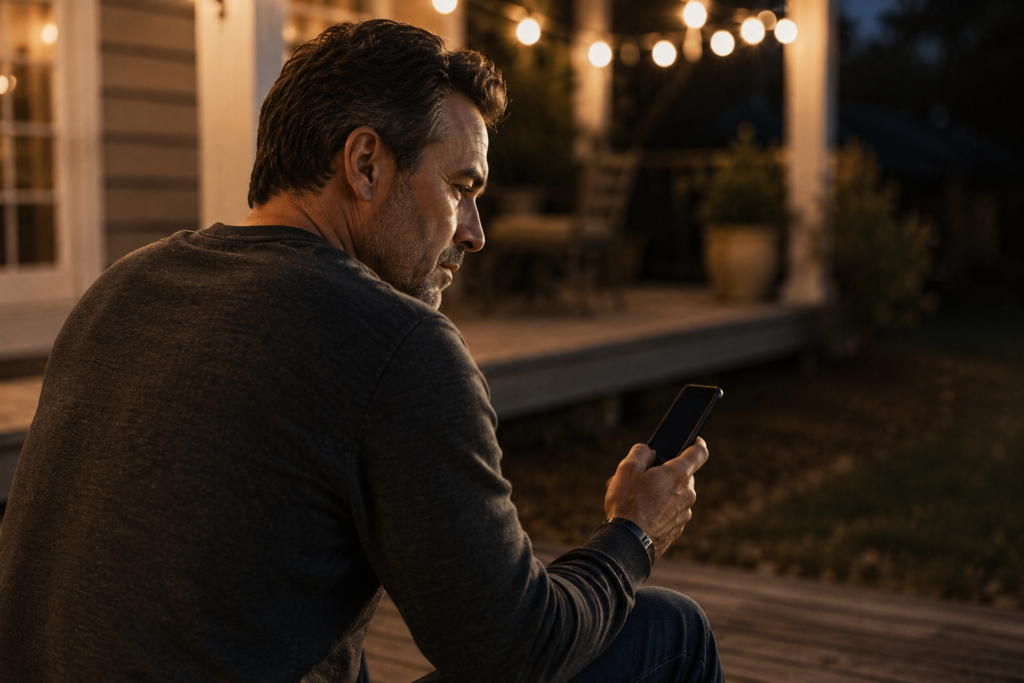
My brother and I hadn’t had a real conversation in almost two years. Not a fight, nothing dramatic, just the slow drift that happens when two people get busy with their own lives and neither one wants to be the one who reaches out first. I’d draft a text every few months and delete it before sending. Too formal, too weird, too much like admitting the distance was a problem worth naming out loud.
The drift didn’t happen all at once. It happened one skipped call at a time, one “we should catch up soon” that never turned into an actual plan. By the time I noticed how long it had actually been, the length of the silence had become its own obstacle. The longer you wait, the more the eventual conversation feels like it needs to address the waiting itself, which makes it feel heavier than it should, which makes you wait even longer. It’s a strange kind of trap that builds its own walls.
What finally got me to hit send wasn’t a big moment. It was a photo I found while cleaning out a box of old stuff, the two of us as kids, maybe eight and eleven, arms around each other at some cousin’s birthday party neither of us would remember without the picture. And the realization that if I died tomorrow, this drifting-apart thing would just be how it ended. That thought bothered me more than I expected it to, more than seemed proportionate to a photo, but it sat with me for the rest of the day.
The text I sent was three sentences. Nothing profound. Just an honest admission that I missed talking to him and didn’t know why we’d let it go this long. No apology exactly, because neither of us had done anything wrong, just an acknowledgment that the silence had gotten bigger than either of us intended. He responded within an hour. Turned out he’d been thinking the same thing, drafting his own version of the same text, stuck in the same loop of almost-reaching-out, each of us waiting for the other to break the pattern first.
We talk regularly now. Nothing heavy, mostly just checking in, sending each other articles, complaining about the same things we always complained about growing up. But the bar I’d built up in my head, the fear that reconnecting would require some big emotional reckoning, a real conversation about why we’d let it slide, turned out to be completely wrong. It just required one honest sentence and the willingness to feel a little exposed for about thirty seconds while I waited to see if he’d respond.
What I’ve come to understand since is that family relationships don’t usually break in a single moment you could point to and fix. They erode in the space between the texts you don’t send, in the small gaps that quietly become large ones. The fix isn’t complicated, and it rarely requires the dramatic conversation you’ve been avoiding. It’s just uncomfortable for exactly as long as it takes to hit send, and then it’s just a conversation again, the way it always used to be.
I’ve thought a lot since about why the delete-and-redraft cycle went on for so long, and I think part of it was pride disguised as caution. Reaching out first can feel, in some quiet corner of your head, like conceding something, like admitting you needed the relationship more than he did. That’s a ridiculous way to think about a brother, but it’s a common enough script among men my age that I doubt I was the only one running it. Nobody ever actually said those stakes existed. I just acted as though they did.
There’s a broader pattern I’ve started noticing in my own life since. The relationships that quietly went dormant, an old college friend, a cousin I used to be close with, all have some version of the same unsent text sitting in a drafts folder somewhere, mental or literal. The bar I’d built up around reaching out to my brother wasn’t actually specific to him. It was a general habit of letting distance calcify because closing it felt like more work, or more risk, than it ever actually turned out to be.
I’ve made a point of applying the same three-sentence approach elsewhere since, with mixed but mostly good results. Not every dormant relationship wants to be reopened, and that’s fine too, that’s useful information in itself. But more often than not, the other person was standing on their own side of the same silence, equally unsure how to end it, equally relieved when someone finally did.