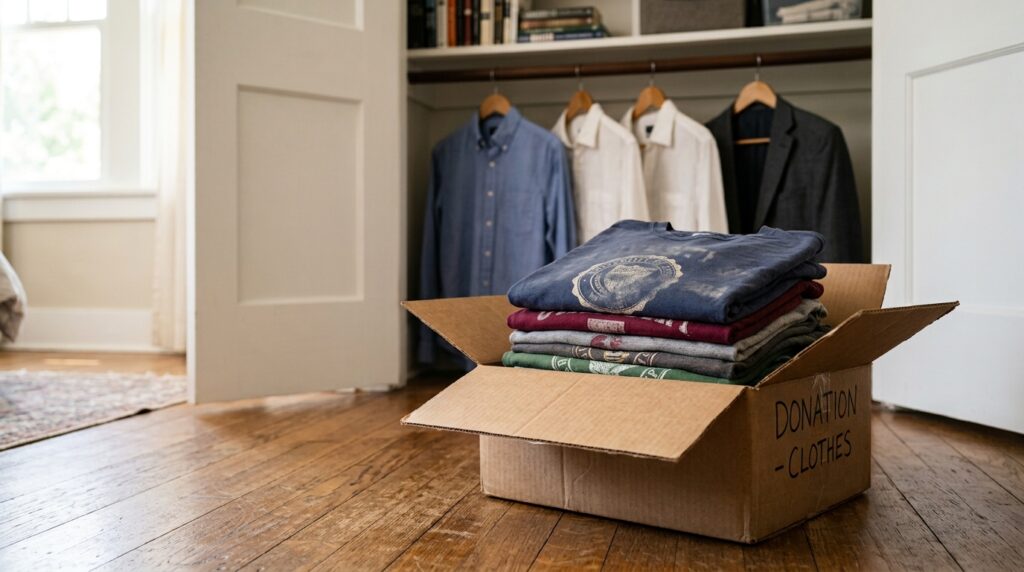
I had a drawer of t-shirts from college that I hadn’t actually worn in probably a decade. Faded, a little too tight in ways that had nothing to do with the shirts changing, but I kept them anyway. Every closet purge, they survived. Sentimental value, I told myself, even though most of them I couldn’t even remember getting, free shirts from events I barely recall attending, a fraternity philanthropy run I have exactly one photo from.
What actually got me to clear them out wasn’t a New Year’s resolution or an organizing binge, the kind that starts strong on a Saturday morning and dies by lunch. It was getting dressed one ordinary morning, reaching past a stack of them for something else, and having the passing thought: would I buy this today, for any reason, at any price? The answer for almost every shirt in that drawer was no, not even close, and once I asked the question that plainly, the sentimental justification I’d been leaning on for a decade just evaporated.
I kept exactly two. One from a trip with my college roommates that I still think about, faded and thin but genuinely tied to a specific good memory I can actually picture. And one I genuinely still wear, soft from age in the good way rather than the sad way. Everything else went into a donation bag, and the drawer that used to be a graveyard of who I used to be became space for clothes I actually put on without a second thought.
What replaced them wasn’t flashy or expensive. A few well-made basics, better fabric than I would have bought at 22, things that actually fit the body I have now instead of the one I used to have, the one that existed only in old photos and my own outdated mental image of myself. It’s a small shift, but getting dressed in the morning got noticeably simpler once the drawer only held things I’d actually choose, rather than a mix of things I wore and things I just hadn’t gotten around to throwing out.
The t-shirts were never really about the t-shirts. They were a low-stakes way of holding onto a version of myself I’d already outgrown, a guy who went to that concert, ran that 5k for a cause he no longer even remembers the name of, belonged to that club. Letting them go didn’t erase that guy or invalidate who he was. It just stopped pretending I still dressed like him, stopped letting a drawer full of expired identity take up space that could hold clothes for the person I actually am now.
There’s a version of this worth trying beyond t-shirts. Anything in your closet you’re keeping for a reason other than actually wearing it is worth the same blunt question: would I buy this today? If the honest answer is no, it’s not really clothing anymore. It’s a souvenir, and souvenirs belong in a box, not in rotation with the clothes you actually live in.
The exercise didn’t stop at t-shirts either, once I saw how well the question worked. I went through the rest of the closet with the same blunt test, and it turned out to apply well beyond casual wear. A couple of dress shirts from a job I hadn’t worked in a decade. A pair of shoes I’d kept “for yard work” that I hadn’t touched in years. Each time, the same honest answer, no, and each time, a little more space freed up for the version of myself actually getting dressed each morning.
What I didn’t expect was how much lighter the whole process of getting ready became afterward. Fewer choices, but better ones. I used to stand in front of a full closet most mornings and somehow still feel like I had nothing to wear, which in hindsight makes sense, most of what was in there wasn’t actually a real option, just clutter dressed up as options. Once the clutter left, choosing got fast again, the way it probably should have been the whole time.
I still think about that box of donated shirts sometimes, imagining them showing up on someone else entirely, a college kid maybe, at the start of the exact chapter I was clearing out the evidence of. There’s something fitting about that. The shirts get to keep being useful to somebody they actually fit, instead of just taking up space as a monument to who I used to be.