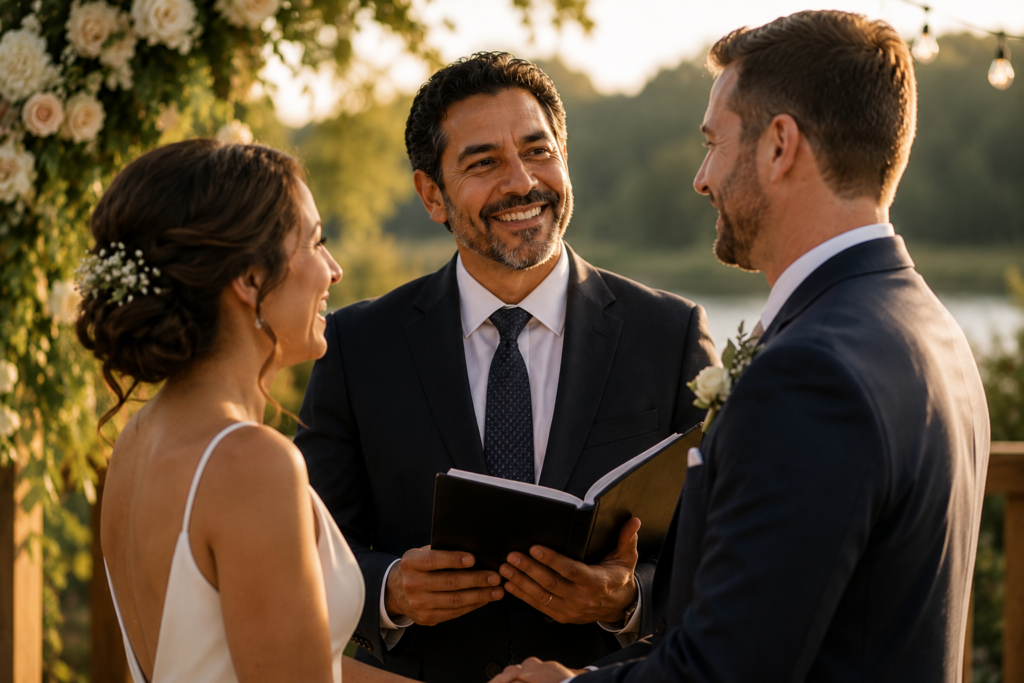
When my best friend asked me to officiate his second wedding, my first reaction was a strange kind of nervousness I hadn’t expected. I’d known him through the collapse of the first marriage, the year afterward that was genuinely rough, more nights on my couch than either of us would probably admit out loud, and now here I was being asked to stand up in front of everyone and vouch for round two.
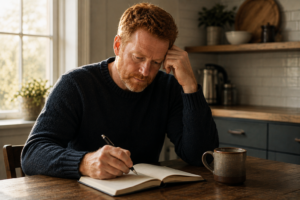
I said yes immediately, because of course I did, but the nervousness sat with me for weeks afterward. Not about the logistics, I’ve spoken in public plenty of times. It was something closer to responsibility. Officiating isn’t just reading words off a page. You’re being asked to publicly stand behind something, to put your name and your presence next to a decision, and I wanted to actually mean whatever I said up there, not just perform the role.
Writing the ceremony forced me to think about what I actually wanted to say, and it wasn’t the usual wedding material you’d pull from a template. I didn’t want to pretend the first marriage hadn’t happened, or talk around it like an embarrassing fact everyone was supposed to politely ignore for the sake of the occasion. Everyone in that room had lived through some version of the first ending. Pretending otherwise would have made the whole ceremony feel hollow, like we were all agreeing to a fiction together.
What I ended up saying was that starting over after something breaks isn’t a failure, it’s evidence that you’re still willing to bet on something good, even after you know exactly how badly it can go wrong. That’s a harder thing to do the second time, not easier. The first time, you don’t know what loss actually feels like up close. The second time, you do, and you’re choosing to risk it anyway, with your eyes fully open. That takes a kind of courage the first marriage never required, because the first marriage got to be naive about it.
Standing up there, watching him actually believe that, was one of the more genuinely moving things I’ve been part of in years. Not because the ceremony was perfect. It wasn’t. I fumbled a line about halfway through, lost my place for a second, had to find it again while forty people watched. But because I got to watch a friend I’d seen at his absolute lowest choose, deliberately and with open eyes, to try again, to bet on something good one more time.
What it taught me wasn’t really about weddings, or even really about second marriages specifically. It was about the particular kind of friendship where you get to witness someone’s full arc, the failure and the recovery both, and still get asked to stand next to them for the next chapter. That’s a different kind of trust than being invited to the good parts only, than being the friend who shows up for the parties and stays out of the mess. It’s the kind you earn by staying through the parts that weren’t good at all, by being on the couch at 2am when there was nothing useful to say, just presence.
I don’t get asked to officiate weddings often, and I doubt I’ll get asked again anytime soon. But if I do, I hope it’s for someone whose whole story I actually know, the hard parts included. Standing up for someone’s best day means more when you were also there for one of their worst.
I’ve thought since about why this felt so different from the first wedding, which I’d also attended, back when we were both younger and neither of us had any real evidence yet of how badly things could go. The first time, everyone in the room was implicitly betting on an unknown. The second time, everyone in the room already knew exactly what failure looked like up close, and showed up anyway to bet again. That’s a room full of people choosing hope with their eyes open, which is a very different thing from a room full of people who simply haven’t been disappointed yet.
I got a text from him a few weeks later, just a photo from the reception with a short caption, something like “couldn’t have done this without you up there.” I don’t think he meant the officiating specifically. I think he meant the couch, the year before, the version of friendship that doesn’t show up in wedding photos but is the whole reason you get asked to stand at the front of the room years later.
It’s changed how I think about my own friendships going forward, honestly. I used to measure closeness by how much fun we had together. I measure it differently now, by whether I’ve actually been present for someone’s hardest stretch, not just their highlight reel. The friends who’ve seen my worst are the ones I trust most with my best, and I suspect that’s true in reverse for most people too.